Start with Brown County’s landscape
Indiana’s official park guide describes Brown County State Park through wooded hills, ridges and ravines, with hiking, mountain biking and other outdoor activities. A private cabin near Nashville can be researched as a base for exploring that wider landscape. The park itself is protected recreation land, not the subject of a purchase recommendation.
Choose the intended household before choosing a complete furniture collection. A smaller cabin can benefit from fewer pieces that each do a clear job. Picture a guest arriving with a travel bag, sitting down with a book and using the dining table after dark; identify the space and surface for each activity.
Use the correct Nashville housing benchmark
Zillow reported a typical home value of $339,729 for Nashville, Indiana, as of September 30, 2026. It is a broad housing index for that location, not a cabin-only sale median, a furnished rental valuation or the budget for a specific Brown County property. Relevant local comparisons remain necessary.
Include inspections, transaction costs, necessary repairs, furnishings and operating reserves alongside acquisition costs. Check the condition and usefulness of anything included with a sale. A cabin can look complete online while needing new seating, a better dining layout or properly sized beds before it delivers the experience a host intends to sell.
Demand qualifies; occupancy still deserves attention
AirDNA’s October 13, 2026 overview showed 295 active listings as of September, with $292 ADR and 48% occupancy. Its Rental Demand subscore was 84. That score qualifies Nashville for this research screen, while the occupancy figure makes clear why a full-year income assumption would be inappropriate.
These are mixed short-term rental market metrics, not cabin-specific results. Compare like-for-like properties, map a monthly calendar and account for unavailable owner nights. Subtract management, cleaning, booking charges, utilities, insurance, taxes, maintenance and replacement reserves. An average booked-night rate is a starting point for analysis, not spendable income or a promise about one cabin.
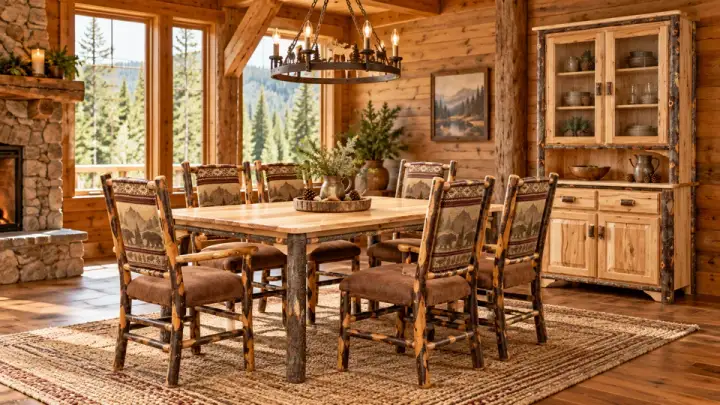
A collected lodge plan with Amish wood
For a compact main room, place the dining table first only if shared meals are the priority; otherwise test the seating arrangement first and compare both sketches. Include every doorway and fixed feature. Do not judge a plan with chairs pushed in and bags absent, because those are precisely the conditions that make an undersized room look larger in photographs.
Our visual direction is a well-proportioned Hickory table or quieter Maple selection where available, with simple supporting fabrics. Check chair dimensions and actual table-base clearance before mixing seats. If a cabinet will hold games or dishes, verify that its doors can open with the table in normal use rather than requiring guests to shift furniture each time.
In a small bedroom, compare the complete bed footprint with bedside storage and luggage placement. A characterful frame may be enough rustic emphasis; a full matching suite is optional. Ask about each item’s available finishes, cleaning guidance and rental-use warranty terms. The purchase should solve a room problem or add a considered visual focal point, without assuming it will support a higher nightly rate.
Investigate the cabin as an operating property
Confirm the parcel’s rental permission, operating obligations and insurance needs with the relevant authorities and qualified professionals. Review water systems, drainage, road upkeep and approach conditions. A tourism destination’s appeal does not establish what a particular property is permitted or equipped to do.
Before ordering furniture, measure the entire delivery route and describe narrow approaches, stairs and tight turns. Eligible pieces may receive free White Glove service within Yoder’s published coverage and conditions, subject to address and access confirmation. Coordinate production and later delivery with the cabin’s readiness before committing to guest arrival dates.